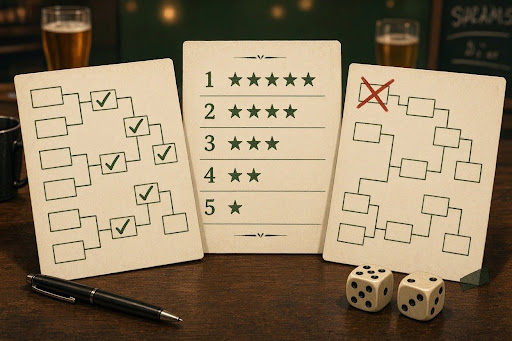
Four football games can produce three different decision problems. Pick’em asks for winners, Confidence asks how to weight those selections, and Survivor asks which single team can carry an entry into the next round. Understanding the scoring system matters before assessing any matchup.
Sports pools also serve a different purpose from bookmaker apps: a page such as دانلود وان ایکس بت 1xbet اندروید concerns access to an Android betting app, while pool platforms collect entries and apply a shared contest's rules. The distinction matters because similar-looking team selections can have different consequences. Begin with the pool's own settings and scoring conditions.
Three Pool Formats, Three Different Objectives
In a straight-up Pick’em format, participants select a winner in each included game. For this example, every correct selection earns one point and an incorrect selection earns none. The task is to finish with the highest total across the four fixtures.
A Confidence pool adds a ranking layer. Here, participants assign the values one through four, using each value exactly once. A correct pick earns its assigned value, so losing the four-point selection hurts more than losing the one-point selection.
Survivor compresses the entry to one team. Under our assumed rules, a win advances the entry, a loss or tie eliminates it, and a team cannot be selected again later in the season. These assumptions describe the worked example; individual pools may allow extra lives, re-entry or other variations.
OfficePoolStop provides separate rules for its pool formats, which is a useful reminder to read the relevant settings. A familiar format name does not settle every scoring question. Straight-up and spread-based selections, in particular, ask different things of the participant.
How the Same Fixtures Lead to Different Choices
Use one fictional round throughout: Falcons versus Bears, Sharks versus Wolves, Hawks versus Bulls, and Tigers versus Foxes. These are invented team labels, not a real schedule. Assume your subjective win estimates favour Falcons at 80%, Sharks at 70%, Hawks at 60% and Tigers at 55%.
For Pick’em, selecting all four favourites gives an expected score of 2.65 points. That is the sum of the four assumed win probabilities, with one point available per game. It describes an average over repeated comparable situations, not a possible guaranteed score for this particular round.
For Confidence, assign four points to Falcons, three to Sharks, two to Hawks and one to Tigers. Under these estimates, the expected total is 7.05 points: 4×0.80 + 3×0.70 + 2×0.60 + 1×0.55. This ordering maximises expected points for this example, although maximising expected points and maximising the chance of winning a particular pool need not be identical objectives.
Now suppose Falcons and Sharks win while Hawks and Tigers lose. The Pick’em entry earns two of four points. The Confidence entry earns seven of ten because its two highest-weighted picks succeeded.
In Survivor, a Falcons selection advances under the same results. Yet the decision before kickoff contains an extra question: have you already used Falcons? If so, the strongest estimated team in this round is unavailable under our no-repeat assumption.
Even if Falcons remain available, choosing them uses a future option. Selecting Sharks instead would accept a lower estimated survival chance this week while preserving Falcons. Whether that trade makes sense depends on later fixtures and remaining eligible teams; the four current games cannot settle it alone.
What to Check Before Joining a Pool
Write down the operative rules before submitting selections. Do not rely on how another pool handled a similar situation last season. Small administrative differences can change both the calculation and the final standings.
Confirm the following:
- Deadlines: individual kickoff times or one lock for the entire round.
- Ties: losses, partial points, pushes or another specified treatment.
- Postponements: whether selections stand, move or become void.
- Tiebreakers: the required prediction and the order of resolution.
- Team reuse: season-long restrictions, resets and postseason treatment.
- Missing picks: elimination, zero points or an automatic selection.
Where bookmaker betting accompanies pool participation, the operator's margin creates a long-run advantage and losses remain possible. Set time and spending limits, and never chase losses. Pool scoring should not be confused with bookmaker pricing.
The fixture list stays the same, but each format changes what a successful decision must accomplish. Pick’em rewards correct selections, Confidence weights their value, and Survivor adds continuity and future availability. Read the settings first, then assess the games through the objective your pool actually uses.