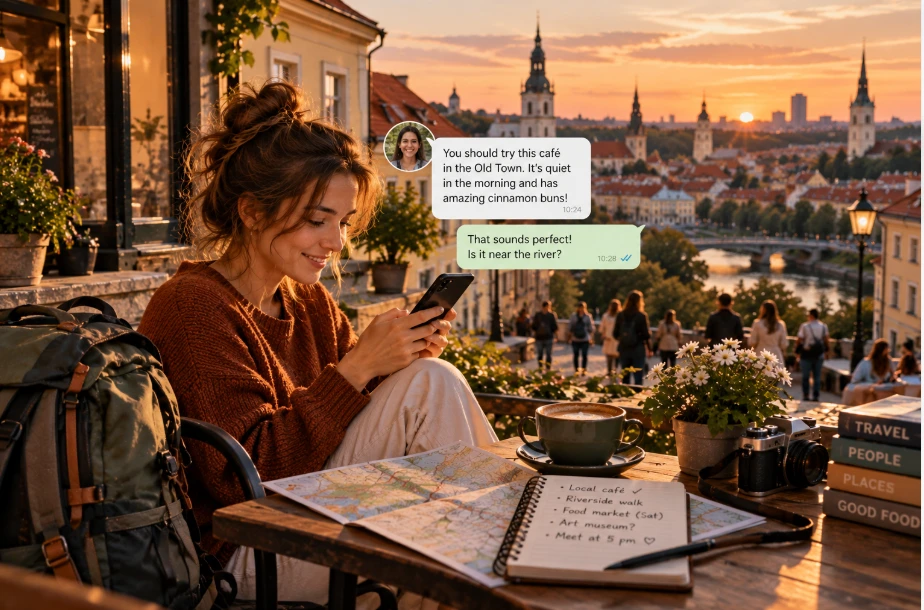
Arriving alone in a new city can be exciting until the first evening, when there is nobody to ask where locals actually eat, which neighborhood is worth walking through, or whether the place you found online is worth crossing town for.
Meeting people before a trip changes that experience. A traveler might join a language exchange, talk in a local hobby group, participate in a travel community, or use a platform such as jump4love to connect with someone abroad. Even if the conversation never turns into an in-person meeting, it can make the destination feel less anonymous.
A recommendation now has a story attached to it. A café becomes the place someone mentioned because they used to study nearby. A neighborhood stops being a colored area on a map and becomes somewhere another person actually spends Saturday afternoons.
That personal context can change solo travel without taking away the independence that makes traveling alone appealing.
Local advice becomes more useful when you know who gave it
Search results tend to produce recommendations designed for the largest possible audience. The same attractions, restaurants, and viewpoints appear repeatedly because they are easy to recommend to almost anyone.
Personal suggestions work differently.
Someone who loves architecture may send you toward residential streets that barely appear in tourist guides. A runner might recommend a riverside route. Another person could tell you that the famous food market is worth visiting early but unpleasant at midday.
The recommendation reflects a person's habits and interests.
That makes one question particularly useful: “Why do you like this place?”
The answer often matters more than the name itself.
If someone loves a restaurant because it is quiet, that information helps a traveler who prefers conversation over nightlife. If they recommend a beach because it has good facilities for children, a solo traveler looking for an empty coastline may choose somewhere else.
Different online spaces lead to different kinds of connections
The platform influences what kind of conversation is likely to happen.
|
Online space |
Useful for |
Common limitation |
|
Language exchanges |
Conversation practice and cultural questions |
Contact may stay focused on learning |
|
Travel communities |
Route advice and destination-specific tips |
Conversations can be brief |
|
Hobby groups |
Meeting people through shared interests |
The group may have little travel focus |
|
Meetup |
Finding activities at the destination |
Depends heavily on local activity |
|
Relationship platforms |
More personal one-to-one conversations |
Expectations should be discussed clearly |
None is automatically the best choice.
A photographer visiting Lisbon might get more from a local photography group than from a general travel forum. Someone staying in Madrid for a month may prefer a language exchange because repeated contact is possible.
The useful question is what you want from the connection before the trip begins.
Online conversations can reveal the ordinary parts of a destination
Tourism content usually emphasizes what is unusual.
Locals spend most of their lives dealing with ordinary things.
They know which supermarket stays open late, which bus route is annoying during rush hour, where people walk after dinner, and which neighborhood has changed enough that old travel advice no longer fits.
Those details can make a solo trip easier.
Imagine arriving in Warsaw after talking for several weeks with someone who lives there. You might already know that their favorite Sunday routine involves coffee in one district followed by a walk in a nearby park.
Trying the same route does not mean copying local life. It simply gives you a starting point that feels more personal than “Top 10 Things to Do.”
A connection can give solo days more structure
One difficult part of solo travel is decision fatigue.
You choose the hotel, transport, meals, route, museums, evening plans, and when to stop. After several days, making every decision alone can become tiring.
A few personal recommendations reduce that load.
Instead of asking, “What should I do tomorrow?”, you have smaller options:
- try the bakery someone recommended;
- visit the neighborhood they mentioned;
- attend the market that is busiest on Saturday;
- check the small concert venue they like;
- walk the route they use on weekends.
The itinerary remains yours. Someone else has simply supplied a few threads to follow.
Meeting in person needs different rules from chatting online
A friendly online conversation can create familiarity quickly. That familiarity should not replace normal travel precautions.
If you decide to meet someone, keep the first plan simple.
- Choose a public place you can reach independently.
- Keep control of your accommodation and transport.
- Tell someone you trust where you are going.
- Avoid making the first meeting dependent on a long drive or remote location.
- Keep enough flexibility to leave if the meeting feels uncomfortable.
A café, market, museum, or busy public square gives both people an easy way to spend an hour together without creating unnecessary pressure.
The goal of the first meeting is not to prove that the online connection was real. It is to see how conversation feels in person.
Shared activities work better than forced conversation
Meeting a stranger for two hours of uninterrupted conversation can feel like an interview.
An activity changes the dynamic.
A local food market gives you things to comment on. A short walking route provides natural pauses. An exhibition creates subjects to discuss without requiring personal questions from the start.
This is especially helpful when people speak different first languages.
Conversation does not need to carry every minute.
If both people like the same activity, even better. Someone you met through a running community can suggest a route. A film fan can recommend a local cinema. A person interested in food may know a neighborhood market that fits naturally into your trip.
Shared interests make the meeting part of the travel experience rather than a separate social appointment.
Personal contact can correct expectations before arrival
Online travel content often creates strong images of a destination.
A city is described as romantic, energetic, relaxed, cheap, expensive, safe, stylish, or underrated. These labels are easy to remember and difficult to apply accurately.
Talking to individuals complicates them in useful ways.
One resident may love living in a city that another person finds exhausting. Someone might warn you away from a neighborhood that their friend considers the best part of town.
Those disagreements prevent you from expecting one correct version of the destination.
The same applies to local culture. One person's family traditions, social habits, or attitude toward tourists should not become evidence for how everyone behaves.
Personal contact works best when it adds perspectives rather than rules.
Staying in touch after the trip changes the memory of a place
Some online connections disappear after a few messages. Others continue long after the flight home.
That changes how a destination is remembered.
A city may become connected to a particular conversation, meal, walk, or person rather than only its monuments. When something happens there months later, you may think of someone who still lives nearby. A future visit begins with an existing connection instead of another blank itinerary.
Solo travel remains independent, but it no longer has to mean experiencing every place as a complete stranger.
Sometimes one local recommendation is enough to change the route. Sometimes a conversation lasts longer than the trip itself.