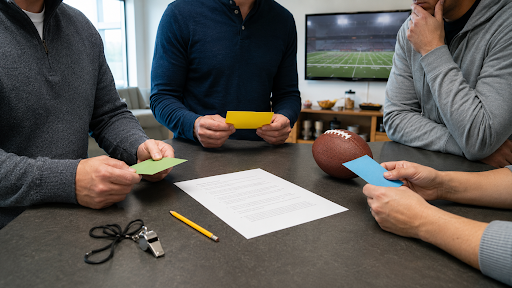
An NFL office pool can run smoothly for months and still be unsettled by one altered kickoff. A Sunday afternoon game moves to Monday, lightning stops play, or an emergency leaves a contest unfinished. Suddenly, a straightforward set of picks raises questions about deadlines, scoring and whether participants may change an earlier choice.
The NFL decides what happens to the game, but a pool manager decides what happens to the entry. Those decisions should already be in the rules. A policy written after an unusual event will almost always look favourable to somebody, even when the manager is trying to be fair.
A New Kickoff Time Changes the Lock
Moving a game before it begins creates the simplest case. In a pool with individual game locks, the pick can remain editable until the revised kickoff. A single weekly deadline works differently: once that deadline passes, every selection stays closed even if one game is later moved.
Payment systems offer a useful comparison because a clearly defined acceptance point prevents later arguments. At $10 Neosurf casinos in Australia, a prepaid voucher code is submitted for validation before the approved amount is added to the casino balance. Once a stake has been accepted and a casino round has started, its recorded terms cannot be changed while settlement waits for the result.
The distinction matters on Thursday nights. Suppose a Pick’em pool locks the entire slate at the opening kickoff of Thursday Night Football. If a Sunday game is subsequently moved to Monday, reopening only that selection would give participants extra time to assess injuries and weather while every other pick remains fixed. Keeping the original weekly lock is defensible, provided the rule was visible before Thursday.
Postponement and Suspension Are Different Events
A postponement occurs before kickoff; a suspension stops a game already in progress. Pool rules should treat them separately because a participant selecting a team in an unstarted contest has received no result, while a suspended game may already have a score and recorded statistics.
The manager needs clear answers to four questions:
- Does a postponed game remain part of the current pool week?
- May a selection be replaced if the new date falls after that week closes?
- Does a resumed game retain its original pool assignment?
- What happens if the NFL does not complete the contest?
Consider a Survivor entry that uses Buffalo in a game postponed before kickoff. Allowing a replacement keeps the entry alive without treating an unplayed fixture as a win. In a Confidence Pool, simply removing that game may distort the scoring if 16 points were assigned to it and the remaining games keep their original values. The cleaner rule either awards no points for that slot to everyone or explains in advance how the points will be reallocated.
The League Result Must Be the Reference Point
Pool software should never invent a winner based on the score at the moment play stopped. Rule 17 of the official 2026 NFL Rulebook gives the Commissioner authority over emergency changes. It states that an interrupted regular-season or postseason game that cannot finish that day is rescheduled and resumed at the point of interruption. For a regular-season rescheduling, the Commissioner is directed to make every effort to place the game no later than two days after its original date and at its original site.
Real events show why a local pool needs its own contingency. The Bills–Bengals game on 2 January 2023 was suspended in the first quarter after Damar Hamlin suffered cardiac arrest and was later cancelled. The NFL recorded no result, and both clubs finished the regular season having played 16 games rather than 17. A Survivor manager could not reasonably grade either team as a winner, while a season-long points pool had to exclude the fixture or apply its stated no-contest rule.
Official stat corrections present a smaller version of the problem. A changed sack, fumble or defensive touchdown may affect fantasy scoring, although it will rarely alter a straight-up Pick’em result. Pools using player statistics should specify an audit window, such as waiting until the league’s published statistics are final before prizes are confirmed.

Each Pool Format Needs Its Own Answer
One universal cancellation clause sounds convenient, yet the consequences differ considerably across formats. The rules can stay concise if each format identifies the result it requires.
- Pick’em: mark an unplayed game void and remove it equally for all entries.
- Confidence Pool: state whether the unused confidence value disappears or whether other values are reassigned.
- Survivor: permit a replacement before a declared cutoff, or mark the selection void without consuming that team.
- Squares: retain the board if the game resumes; declare in advance how an official no-contest affects the prize pool.
There is also a practical issue with visible picks. If selections become public at the original kickoff, reopening them after a postponement lets participants see rival choices before editing their own. A fair replacement window may therefore require hidden picks, a manager-recorded substitute or a fixed default team.
A Short Rulebook Prevents a Long Dispute
Good pool rules do not need to predict every storm, stadium problem or league decision. They need a consistent order of authority: official NFL status first, the pool’s written policy second and manager discretion only for a case the policy genuinely does not cover.
Before Week 1, the manager should record the lock method, the treatment of postponed and suspended games, the source used for final results and the deadline for corrections. The policy should also explain whether replacement picks consume a team in Survivor and how removed games affect confidence points.
Schedule disruptions are rare, which makes them easy to ignore during setup. They are also the moments when a pool’s rules receive their hardest test. A few precise sentences written before the opening kickoff can protect an entire season of picks.