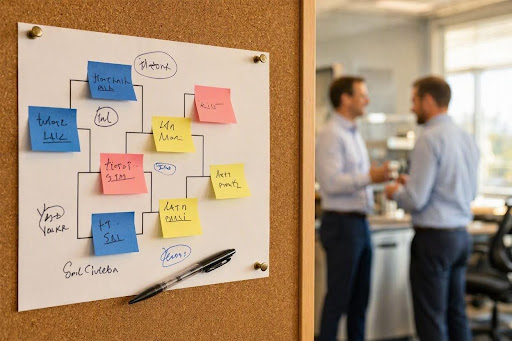
Every office has one colleague who picks winners with a spreadsheet and another who picks by mascot preference, and the spreadsheet rarely wins more often than chance would predict. That is not a coincidence specific to any one workplace. It reflects a well-documented quirk in how people handicap outcomes casually, one that shows up in office brackets just as clearly as it shows up on platforms like onjabet built around the same predictive impulse.
The gut-pick habit is not simple laziness. Group prediction games reward social confidence as much as analytical accuracy, since a bold, memorable pick generates conversation even when it loses. A cautious, stats-driven pick rarely gets discussed around the coffee machine regardless of how it performs.
Why Confidence Beats Accuracy in a Casual Pool
Behavioral researchers call this a form of narrative bias: people trust a good story about why an underdog will win more than they trust a probability. An office pool amplifies that bias because the audience is social rather than financial. Being memorably wrong costs nothing but pride, while being quietly correct earns little recognition.
This dynamic explains why the same handful of colleagues tend to make bold picks every single year regardless of how the previous year's bracket performed. Their identity within the pool is built around being the bold picker, not the accurate one, and that identity persists independent of actual results.
Office culture reinforces the pattern further. A pool is often one of the few shared, informal rituals left in a workplace, so participation itself carries social value separate from the outcome. Colleagues who rarely discuss sports the rest of the year will happily debate a bracket for two weeks, which suggests the appeal has more to do with shared conversation than any real interest in probability.
What Actually Predicts a Good Office Pool Experience
A few patterns are worth knowing before the next bracket season starts:
• Group size matters more than individual skill; larger pools reward variance over consistency, so bold outliers win disproportionately often.
• Early picks tend to be more analytical, while late picks in a pool often chase whoever is currently leading.
• Pools with a light-hearted prize (bragging rights, a trophy mug) generate more genuinely random picking than pools built around real stakes.
• The most consistently accurate picker across several years is rarely the loudest voice in the pool.
• Pools that publish a simple running leaderboard tend to sustain engagement longer than pools that only reveal results at the very end.
Office pools work precisely because they stay low-stakes and social rather than becoming a serious financial exercise. Anyone who wants a more analytical version of the same prediction habit should treat it as a separate, clearly budgeted activity rather than blending the two, since real-money platforms are built around a house edge that a friendly office bracket simply does not have.
The next time a confident colleague nails an upset pick, resist the urge to assume they saw something the spreadsheet missed. More often, they just told a better story about why it would happen — and told it loudly enough that everyone remembers.
That said, the spreadsheet colleague is not necessarily wrong to keep bringing the numbers every year. A quieter, more consistent process still tends to hold up better across many pools over many years, even if it rarely produces the single loudest story at the coffee machine. The two approaches are not really competing for the same prize, which is probably why both keep showing up in the same office pool year after year.